Letter in Science challenges Alberta’s ill-advised black bear hunting policy

Alberta has brought back a controversial hunting practice that puts black bears – and the science behind their management –…

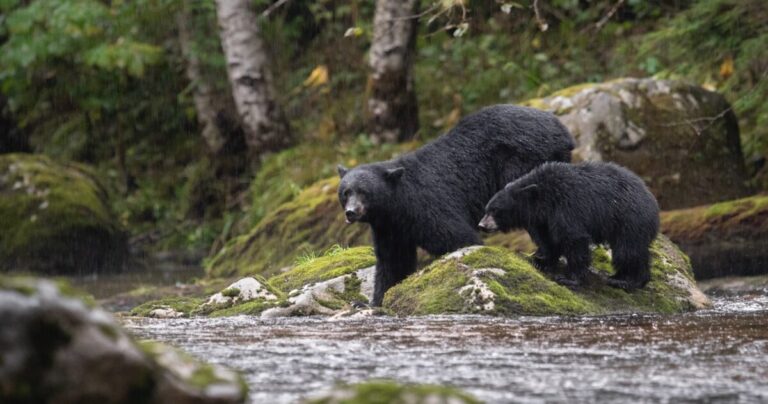
Alberta has brought back a controversial hunting practice that puts black bears – and the science behind their management –…

When resources become scarce, cooperation can be put to the test. A new open access study published in Marine Mammal…

New research from the University of Windsor and Raincoast Conservation Foundation confirms that endangered St. Lawrence belugas show strong spatial…

Wild Pacific salmon are among Canada’s most iconic species. They nourish forests, sustain countless wildlife species, support Indigenous cultures and…

Juvenile Chinook salmon in the Lower Fraser River estuary are feeding and growing in a slurry of contaminants, from pharmaceuticals…

A new study reveals that toxic hotspots for polycyclic aromatic hydrocarbons (PAHs) in marine sediments exist in parts of the…

As climate change drives river temperatures to record highs across Western North America, the ability of salmon to survive depends…

The Wild Salmon Policy was introduced two decades ago as a comprehensive framework for conserving the ecological and genetic diversity…

Raincoast’s Healthy Waters Program was designed to assess the impacts of human activities on water quality in British Columbia, so…

Like Google Maps for Salmon-seeking Bears, a new study, “Modeling Functional Connectivity for Bears Among Spawning Salmon Waterways in Haíɫzaqv…

Beluga whales are known for their rich and varied vocalizations, earning them the nickname “canaries of the sea.” But beyond…

Environmental DNA (eDNA) is an increasingly utilized tool in the conservation world that helps us identify the presence or absence…

In the Lower Fraser River and Estuary, log booming, where bundles of logs are tied up and stored along the…

In collaboration with Indigenous leaders, lawyers, and researchers from the Indigenous-led Lower Fraser Fisheries Alliance, the Martin Conservation Decisions Lab…

Raincoast, in collaboration with a team of international scientists, authored a new study on the potential to recover the critically…

A new study, “Influence of ecotourism on grizzly bear activity depends on salmon abundance in the Atnarko River corridor, Nuxalk…

Published in the journal Ecology & Evolution, a new paper titled “Human disturbance in riparian areas disrupts predator-prey interactions between…

Wolf control, often presented as a ‘solution’ to stabilize caribou populations, ultimately allows continued approval by governments of resource exploitation,…

Many species of birds and mammals exhibit intraspecific acoustic geographic variation in their vocalizations. This occurs when populations are separated…

New research on the planet’s ‘Keystone Species’ has revealed a staggering and unappreciated diversity in what kind of animal fits…

The June 30th, 2023 edition of the journal Science features a letter written by Raincoast science staff on the repercussions…

New research examining the ecological niche of humans shows that over one third of all vertebrate species on Earth are…

The endangered Southern Resident killer whale population isn’t getting enough to eat, and hasn’t been since 2018, a new study,…

The relationship between terrestrial and marine environments within an ecosystem is essential. Newly published research from Simon Fraser University shows…
Pink Sheep Media is a design and communications company.
This is our community hub. We have so many incredible researchers, writers, creators, and change-makers in our community.